Example 6: Van der Pol oscillator
MMS example on a Van der Pol oscillator. This configuration is very close from that studied by Nayfeh and Mook in Nonlinear Oscillations (1995), section 3.3.4.
System description
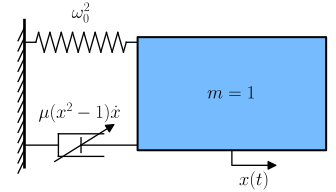
Illustration of a Van der Pol oscillator.
The system’s equation is
where
\(x\) is the oscillator’s coordinate,
\(t\) is the time,
\(\dot{(\bullet)} = \mathrm{d}(\bullet)/\mathrm{d}t\) is a time derivative,
\(\omega_0\) is the oscillator’s natural frequency,
\(\mu\) is the linear and nonlinear damping coefficient.
A parametric response around the oscillator’s frequency is sought so the frequency is set to
where
\(\epsilon\) is a small parameter involved in the MMS,
\(\sigma\) is the detuning wrt the reference frequency \(\omega_0\).
The parameter \(\mu = \epsilon \tilde{\mu}\) is then scaled such that
to indicate that linear and nonlinear dampings are weak.
Code description
The script below allows to
Construct the dynamical system.
Apply the MMS to the system,
Solve the modulation equations (yields the transient response),
Evaluate the MMS results at steady state,
Solve the steady state modulation equations (yields the limit cycle),
Evaluate the symbolic expressions for given numerical parameters and plot the limit cycle and two trajectories in the phase portrait.
  1# -*- coding: utf-8 -*-
  2
  3#%% Imports and initialisation
  4from sympy import symbols, Function, sympify, solve, dsolve, cos, sin
  5from sympy.physics.vector.printing import init_vprinting, vlatex
  6init_vprinting(use_latex=True, forecolor='White')
  7from oscilate import MMS
  8
  9# Parameters and variables
 10omega0, c = symbols(r'\omega_0, c', real=True, positive=True)
 11mu        = symbols(r'\mu', real=True, positive=True)
 12t         = symbols('t')
 13x         = Function(r'x', real=True)(t)
 14
 15# Dynamical system
 16Eq = x.diff(t,2) + omega0**2*x + mu*(x**2 - 1 )*x.diff(t)
 17dyn = MMS.dyn_sys.Dynamical_system(t, x, Eq, omega0, F=0)
 18
 19# Initialisation of the MMS sytem
 20eps            = symbols(r"\epsilon", real=True, positive=True) # Small parameter epsilon
 21Ne             = 2      # Order of the expansions
 22omega_ref      = sympify(1) # Reference frequency
 23ratio_omegaMMS = 1      # Look for a solution around omega_ref
 24
 25sigma0          = symbols(r"\sigma_0", real=True) # Detuning of omega0 wrt 1
 26detunings       = [sigma0] # Detuning of the oscillator's frequency
 27sub_sigma0      = [(sigma0, omega0-1)] # Only for display purposes
 28
 29param_to_scale = (mu, sigma0)
 30scaling        = (1 , 1     )
 31param_scaled, sub_scaling = MMS.scale_parameters(param_to_scale, scaling, eps)
 32
 33kwargs_mms = dict(ratio_omegaMMS=ratio_omegaMMS, ratio_omega_osc=[1], detunings=detunings)
 34mms = MMS.Multiple_scales_system(dyn, eps, Ne, omega_ref, sub_scaling, **kwargs_mms)
 35
 36# Application of the MMS
 37mms.apply_MMS(rewrite_polar="all")
 38
 39# Transient analysis - slow time solutions
 40Eqa    = mms.coord.at[0].diff(t)                    - mms.sol.fa[0]    # Equation on a
 41Eqbeta = mms.coord.at[0]*mms.coord.betat[0].diff(t) - mms.sol.fbeta[0] # Equation on beta
 42ai    = symbols(r"a_i", real=True, positive=True)     # Initial amplitude
 43betai = symbols(r"\beta_i", real=True, positive=True) # Initial phase
 44ICa = {mms.coord.at[0].subs(t,0) : ai}           # Initial condition on a
 45ICbeta = {mms.coord.betat[0].subs(t,0) : betai}  # Initial condition on beta
 46a_sol    = dsolve(Eqa, mms.coord.at[0], ics=ICa).rhs.subs(mms.sub.sub_scaling_back).subs(sigma0+1, omega0)
 47beta_sol = dsolve(Eqbeta, mms.coord.betat[0], ics=ICbeta).rhs.subs(mms.coord.at[0], a_sol).doit().expand().simplify().subs(mms.sub.sub_scaling_back).subs(sigma0+1, omega0)
 48
 49# Transient analysis - instantaneous oscillation frequency and time response
 50psi = Function(r"\psi", real=True, positive=True)(t) # Full phase
 51sub_psi = [(mms.omega*t, psi+mms.coord.betat[0])]     # Substitution from the relative phase beta to the full one psi
 52psi_sol = (mms.omega*t - beta_sol).subs([mms.sub.sub_omega]).expand().simplify() # From the beta solution to the psi one
 53omegaNL = psi_sol.diff(t).simplify().factor() # Instantaneous oscillation frequency
 54list_cos_sin = list(mms.sol.x[0].atoms(cos, sin)) # List of harmonics in the response
 55x_sol = mms.sol.x[0].expand().collect(list_cos_sin).subs(mms.sub.sub_t[:-1]).subs(mms.sub.sub_scaling_back).subs(sub_psi).simplify() # Time signal
 56
 57# Evaluation at steady state
 58ss = MMS.Steady_state(mms)
 59
 60# Steady state analysis - amplitude and frequency
 61aSS_sol     = solve(ss.sol.fa[0], ss.coord.a[0])[0] # Amplitude solution
 62sigSS_sol   = solve(ss.sol.fbeta[0], mms.sigma)[0].subs(ss.coord.a[0], aSS_sol) # Detuning solution
 63omegaSS_sol = (1 + eps*sigSS_sol).subs(mms.sub.sub_scaling_back).simplify() # Frequency solution
 64sub_SS_sol  = [(ss.coord.a[0], aSS_sol), (mms.sigma, sigSS_sol)] # Substitutions to steady state solutions
 65xSS_sol = mms.sol.x[0].expand().collect(list_cos_sin).subs(mms.sub.sub_t[:-1]).subs(ss.sub.sub_SS).subs(mms.sub.sub_scaling_back) # Time signal
 66
 67# Steady state analysis - Stability analysis
 68J   = ss.Jacobian_polar() # Jacobian of the slow time system (in polar coordinates)
 69JSS = J.applyfunc(lambda expr: expr.subs(sub_SS_sol).subs(mms.sub.sub_scaling_back)) # Jacobian evaluated on the steady state solution
 70eigvals = list(JSS.eigenvals().keys()) # Eigenvalues
 71eigvecs = list([item[2][0] for item in JSS.eigenvects()]) # Eigenvectors
 72
 73# Phase portrait - Numerical evaluation of the symbolic solutions
 74print("Numerical evaluation")
 75from oscilate.sympy_functions import sympy_to_numpy
 76import numpy as np
 77
 78def get_x_v(omega0_num, mu_num, SS=False, **kwargs):
 79    """
 80    Retrieve the numerical expressions of the displacement x and velocity v from the symbolic results, for a given set of numerical parameters
 81    """
 82
 83    sigma0_num = 1 - omega0_num # Detuning
 84
 85    dic_time   = {
 86        "epsilon" : (mu, mu_num),
 87        "sigma0": (sigma0, sigma0_num),
 88        "omega0": (omega0, omega0_num)
 89    }
 90
 91    if SS: # Limit cycle
 92        a_num     = sympy_to_numpy(aSS_sol, dic_time) # Amplitude response at steady state
 93        omega_num = sympy_to_numpy(omegaSS_sol, dic_time) # Frequency of the response at steady state
 94        t_num = np.linspace(0, 2*np.pi/omega_num, 10000)
 95
 96        dic_a_beta = {
 97            "t": (t, t_num),
 98            "a": (ss.coord.a[0], a_num),
 99            "beta": (ss.coord.beta[0], 0),
100            "omega": (mms.omega, omega_num)
101        }
102
103        vSS_sol  = xSS_sol.diff(t) # Symbolic expression of the velocity at steady state
104        x = sympy_to_numpy(xSS_sol, dic_time | dic_a_beta) # Displacement at steady state
105        v = sympy_to_numpy(vSS_sol, dic_time | dic_a_beta) # Velocity at steady state
106
107    else: # Transient trajectories
108        ai_num, t_num  = list(map(kwargs.get,["ai","t"]))
109        dic_time["t"]     = (t, t_num)
110        dic_time["ai"]    = (ai, ai_num)
111        dic_time["betai"] = (betai, 0)
112
113        dic_a_psi = {
114        "a": (mms.coord.at[0], sympy_to_numpy(a_sol, dic_time)),
115        "psi": (psi, sympy_to_numpy(psi_sol, dic_time)),
116        "da": (mms.coord.at[0].diff(t), sympy_to_numpy(a_sol.diff(t).simplify(), dic_time)),
117        "dpsi": (psi.diff(t), sympy_to_numpy(psi_sol.diff(t).simplify(), dic_time))
118        }
119
120        v_sol = x_sol.diff(t)
121        x = sympy_to_numpy(x_sol, dic_time | dic_a_psi)
122        v = sympy_to_numpy(v_sol, dic_time | dic_a_psi)
123
124    return x, v
125omega0_num = 0.8
126mu_num     = 0.3
127xLC, vLC = get_x_v(omega0_num, mu_num, SS=True)
128xLT, vLT = get_x_v(omega0_num, mu_num, SS=False, **dict(ai=0.5, t=np.linspace(0, 60, 10000)))
129xUT, vUT = get_x_v(omega0_num, mu_num, SS=False, **dict(ai=3.5, t=np.linspace(0, 60, 10000)))
130
131# Plot the phase portrait
132import matplotlib.pyplot as plt
133
134fig, ax = plt.subplots()
135ax.plot(xLC, vLC, c="k", lw=2, zorder=3)
136ax.plot(xLT, vLT, c="tab:blue")
137ax.plot(xLT[0], vLT[0], marker="o", mfc="tab:blue", mec="none", ms=4)
138ax.plot(xUT, vUT, c="tab:red")
139ax.plot(xUT[0], vUT[0], marker="o", mfc="tab:red", mec="none", ms=4)
140ax.set_xlabel(r"${}$".format(vlatex(x)))
141ax.set_ylabel(r"${}$".format(vlatex(x.diff(t))))
142
143# %%